
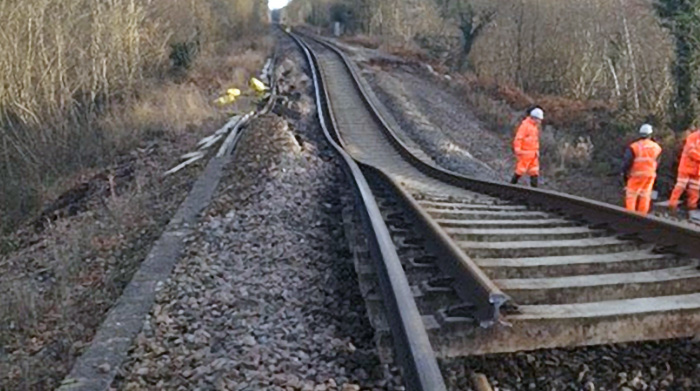
Landslips and embankment failures can happen without warning – sometimes after heavy rainfall – bringing chaos to busy transport routes. When disaster strikes you need creativity as well as a rapid response.
As civil engineering specialists Suttle Projects has been called in to help after many landslips and embankment failures. The need to be highly responsive is pretty self-evident. Normally we’d have experts onsite the same day assessing the extent of the failure and evaluating short and long-term solutions.
This is where the creative part comes in. There are typically several options for stabilising the situation and preventing further damage. Ideally you want to get the rail line up and running again as quickly as possible. But you don’t want those measures to complicate the longer-term solution.
Options
A review of a few of the projects we’ve been involved in shows the variety of stabilisation and remediation options available. These include appointments either direct to Network Rail or in close collaboration with a main contractors and designers.
Stabilising the rail embankment at Hamble during a 55-hour possession involved a combination of kingpost wall construction and grouted anchor soil nailing. H-pile steels and concrete panels secured the upper embankment, followed by soil nailing and compaction along the lower part of the slope to provide a neat and resilient solution.
After torrential prolonged periods of rain, the Botley embankment suffered a large-scale collapse, closing the railway between Eastleigh and Fareham. The solution involved installing over 1800 Larssen sheet piles in various lengths after excavating 35,000 tonnes of saturated material.
There was also a support system of heavy Macalloy tie rods and walings between sheet pile walls over the critical failure section. Finally the site was backfilled with over 40,000t of crushed aggregate levelled in 150mm layers. Over 1,000m of drainage was added to enhance the long-term stability of the completed embankment.
Preventive Works and Resilience
Ideally, remedial works are carried out before there’s a catastrophic failure – as they were with the Langport embankment in Somerset. Track settlement and subsidence were putting the embankment at risk and Suttle Projects was engaged was engaged directly by Network Rail to install corrective measures.
The corrective measures included over 800 metres of sheet piling up to 23m in length, either side of the railway embankment. Our engineers noticed that no provision had been made in the original design to retain the embankment at the intersection with the existing River Parrett viaduct – risking potential slope instability. A solution was agreed quickly with the client’s designer and corrective measures taken preventing any impact to the completion programme.
Handling 23m long piles so close to the running lines, presented a high risk of piles encroaching the railway. So we developed an innovative piling ‘gate’ that acted as a physical barrier – removing the need to close the line. A twin wall pipe and catchpit system was also provided behind the ballast boards on the upper section to improve and future-proof the embankment’s drainage.
No two failures or locations will be identical. Having a range of options and an open-minded approach is the best way to achieve a time and cost-effective outcome.
To find out more, head over to our information and insights section.