
Eliminating project risks and increasing efficiency: these are vital considerations for any significant civils project, surely. Which raises the question of why you’d ever undertake one of these projects without access to detailed geotechnical data.
Perhaps one reason is that the full value of investing in a geotechnical survey tends to appear in hindsight. Only then can you quantify the time and cost saved by pre-empting, rather than reacting to issues, and avoiding late redesigns because of unexpected sub-surface conditions and obstructions.
Geotechnical intelligence helps you do more than just avoid problems. The most effective and efficient technical solution is almost always influenced by geotechnical factors. Planning without this data is like trying to find a destination with only half a map.
Simpler Project Delivery
Geotechnical surveys are an investment. The chief dividend is simpler projects, delivered on-time and on-budget. Other pay-backs can include reduced material use and fewer vehicle movements. Geotechnical data helps to simplify project delivery by identifying the optimum technical solution, materials and plant from an early stage of the project.
You can boil down all of the above into effective management of project risks and achieving more efficient delivery. Who wouldn’t want that?
Geotechnical Data: Practical Benefits
So much for the theory, how does it work in practice? Time for a few examples…
Certainty is never more important than when dealing with an emergency such as an embankment failure. For the Colhayne Embankment emergency works, rapid geotechnical analysis under tight access and ecological constraints identified gabion baskets and ground anchors as the most effective stabilisation method. Simplifying the project in this way gave absolute assurance that we would meet the possession deadline.
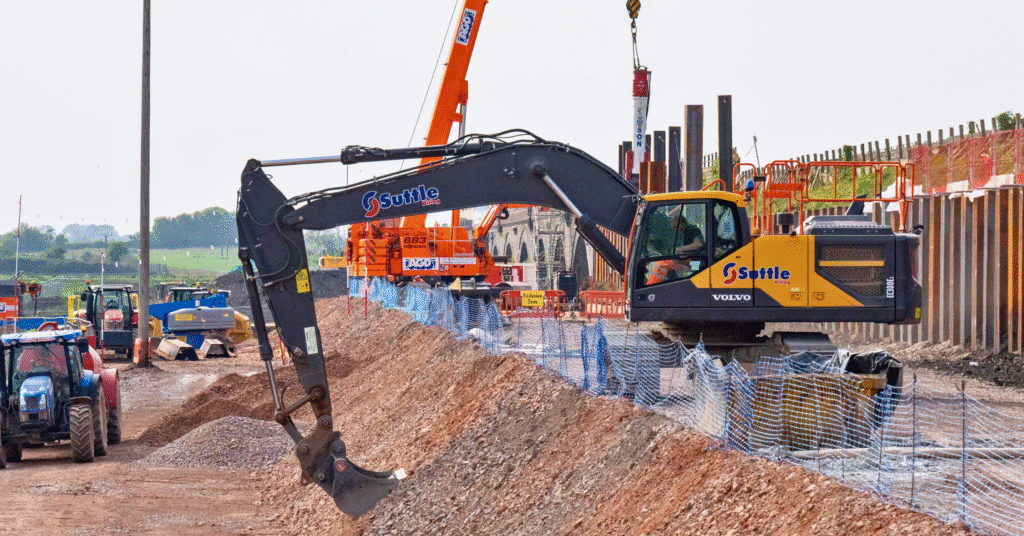
For the long-term Langport Embankment stabilisation, geotechnical expertise recognised the opportunity for an onsite quarrying and recycling approach, this enabled less than 0.4% of the project’s waste to go to landfill, 15% of the materials excavated onsite to be re-used – also minimising vehicle movements. Other waste material was recycled at source to supply the local construction industry, with the proceeds being fed directly into project cost savings.
We applied a similar principle during the Stokes Bay sea defence renewal. Ground profiling and material suitability assessments allowed our team to re-use 220 tonnes of the damaged seawall concrete on site, rather than having to remove it.
To find out more about our projects simplified approach, sign-up to our information and insights section below.
