
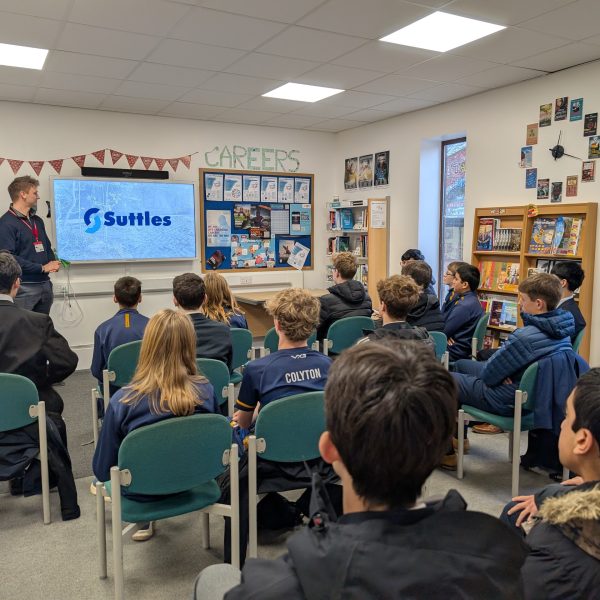
Suttle Projects’ graduate engineer Tom Osborne is one of our engineers currently working on the Network Rail CP7 framework. He is also an Old Colytonian, having previously attended Colyton Grammar School in Devon, making a recent visit to the school particularly meaningful.
Towards the end of last year, CECA South West; the regional body for the Civil Engineering Contractors Association in the South West circulated a call for volunteers to support a Year 8 STEM project at Colyton Grammar School. When Tom saw the request and recognised the school he once attended, he didn’t hesitate to get in touch and volunteer his time.
Supporting initiatives like this is an important way for engineers to share their experiences and inspire the next generation to explore careers in science, technology, engineering and mathematics (STEM). By volunteering as part of the project, Tom was able to give students an insight into the real-world applications of engineering and the many opportunities the industry can offer.
The project itself is something the school has run for the past couple of years and hopes to establish as an annual initiative. It gives students the opportunity to work on a project outside their usual curriculum, but one centred around key STEM attributes. The aim is to encourage students to “think like an engineer”, developing skills such as problem-solving, creativity, teamwork and critical thinking.
Working in small groups they had chosen themselves, the students were tasked with identifying a challenge facing society and developing a potential solution. Over the course of the project they will research their chosen topic, explore possible solutions and ultimately produce both a written report and a presentation explaining their ideas.
To kick the project off at the end of February, Tom visited the school to deliver a presentation introducing students to the work we do at Suttle Projects and the types of projects our teams are involved in. The session provided a valuable opportunity for students to learn more about civil engineering and the role it plays in shaping and improving the world around us.
Following the presentation, Tom stayed on to support the students as they began forming their groups and deciding the focus of their projects. Acting as a mentor, he was able to answer questions, help guide their thinking and encourage them to consider problems from an engineering perspective.
Many of the themes the students chose centred around real-world challenges that affect people across the country. These included ideas focused on reducing and monitoring screen time among younger generations, addressing the impacts of the cost-of-living crisis, tackling homelessness, and exploring potential improvements that could be made to the rail industry.
It was clear from the outset that the students were already thinking creatively about the challenges they had chosen, with many groups demonstrating impressive enthusiasm and innovative thinking. There are still several weeks to go before the project concludes and a winning group is selected. In the meantime, the students will continue developing their ideas and refining their proposals, supported by teachers and mentors.
Initiatives like this highlight the importance of engaging young people with STEM subjects and showing them how the skills they develop in the classroom can be applied to real-world problems. We’re proud that Tom was able to give back to his former school and help inspire the next generation.