
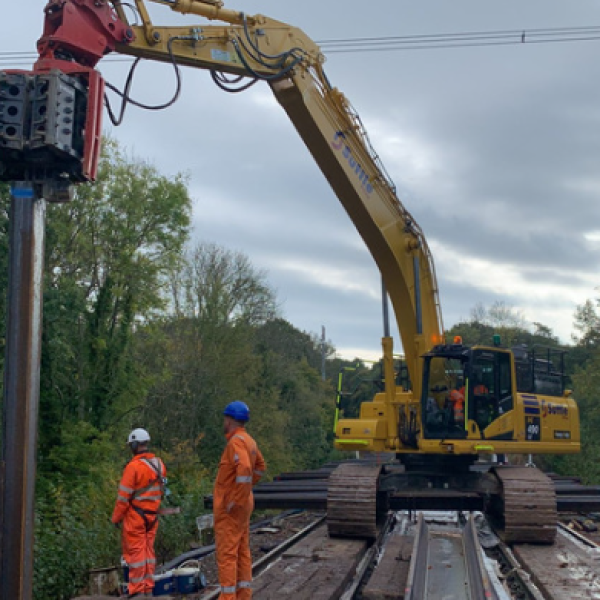
Difficult access is more or less a given when you respond to a rail emergency such as a failed embankment, landslip or drainage failure. The failure will almost inevitably be in a remote location and access to the site may have to be through narrow lanes.
Plant and materials might have to cross soft ground or a narrow bridge with a weight restriction. The site could be constrained by the topography or obstructions such as overhead power lines. It might offer limited scope to lift or manoeuvre piles, gabions or whatever else will be needed to stabilise the structure. And it’s not unusual for the location to be environmentally sensitive.
What doesn’t change is the level of urgency. Railways are vital economic and social arteries and they need to be kept flowing.
Far from putting us off getting involved with reactive repairs, Suttle Projects embraces the challenge – after all, there’s not much point joining the engineering profession if you don’t relish solving problems.
Know The Risks, And Manage Them
Like any civil engineering project, success follows when you accurately identify, quantify and mitigate the risks. For emergency responses the specific risks won’t be known until the site can be inspected. Getting expertise to the location of the failure as quickly as possible is always the first priority.
And while we don’t know the specific risks and complications for a given failure, we do have a shortlist and contingency plans. Through experience we know what circumstances we’re likely to face. And we know exactly where and how we can source the equipment skills and resources that will be needed to handle the site constraints. This is the core of our projects: simplified approach.
Process and Communication
Beyond that it’s largely a question of process and communication. Site data is transmitted to designers and engineers to begin devising a robust and cost-effective solution. This could be a two-phase approach to stabilise the situation until a longer-term remedy can be completed.
Equipment, transport and materials frequently come from our own resources. There’s a simple reason behind this: we need to be certain they’ll be available as a high priority when needed. If we urgently need a certain type of piling rig, smaller transport vehicles because of weight restrictions, or substantial quantities of gabion baskets and stone, we know from experience that self-delivery is more reliable.
Time-critical reactive repairs are where our projects: simplified approach comes into its own. Head over to our information and insights section below to find out more.